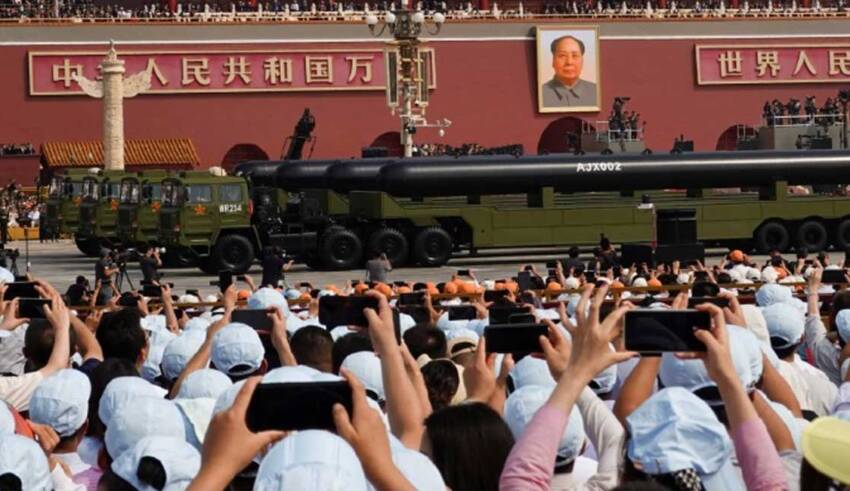
Beijing, Wednesday — China staged its first large-scale military parade in six years, highlighting advances in its ongoing modernization drive with weaponry ranging from undersea drones to long-range nuclear missiles.
The event marked the 80th anniversary of the end of World War II. Chinese officials said the showcase demonstrated how the People’s Liberation Army (PLA) is harnessing cutting-edge technology to prepare for future conflicts. Analysts abroad noted the parade was as much about sending signals of deterrence — to the United States, its allies, and regional rivals — as it was about celebrating history.
Expanding Military Capabilities
This year’s parade underlined China’s efforts to strengthen battle management and communications networks that can integrate various systems in wartime.
The 2015 “Victory Parade” focused on nuclear-capable missiles.
In 2019, drones appeared for the first time.
In 2025, China unveiled significant upgrades across all domains — air, land, sea, space, and cyber.
Key Highlights of the Parade
Nuclear Triad
For the first time, China publicly displayed the full “nuclear triad” — weapons deployable from land, air, and sea.
DF-5C ballistic missile: An upgraded system capable of striking global targets.
Air-launched nuclear weapon: Expanding reach from the skies.
JL-3 missile: The latest submarine-launched ballistic missile, ensuring second-strike capability in line with China’s “no first use” nuclear policy.
DF-61 ICBM
Western analysts are closely studying the new DF-61 intercontinental ballistic missile. Road-mobile and easier to conceal than silo-based systems, it could provide China with a more survivable nuclear force.
H-6N Strategic Bomber
China also flew the H-6N, an upgraded Cold War-era bomber adapted to carry nuclear weapons and extend range. Though eventually set to be replaced by a stealth bomber, the H-6N has been increasingly active along China’s coastline.
JL-3 Submarine-Launched Missile
Considered the most critical part of the triad, the JL-3 equips nuclear-powered submarines based in the South China Sea. It enhances China’s deterrent by ensuring a retaliatory strike capability even if land-based systems are destroyed.
Underwater Drones
A surprise element was the debut of torpedo-shaped undersea drones. If produced at scale, they could complicate naval operations for rival forces. Analysts, however, remain uncertain about how effectively these systems could be deployed in real combat.
Laser and Microwave Weapons
The PLA unveiled its evolving anti-drone “triad”, including:
High-energy lasers,
Microwave-based systems, and
Missile-gun hybrids.
While lasers could one day target missiles or even satellites, their effectiveness remains under development. Microwaves present deployment challenges due to risks of interference with friendly forces.
Hypersonic Missiles
China showcased hypersonic anti-ship missiles — YJ-15, YJ-17, YJ-19, and YJ-20 — some tested against mock U.S. aircraft carrier models. These weapons, deployable from land, sea, and air, pose a growing challenge to U.S. and allied fleets in East Asia.
Counting the Hardware
The assessment of weaponry was based on full broadcasts by China’s state-run CCTV, cross-referenced with Reuters images, military websites, and expert input. Due to visibility issues, some counts may contain minor discrepancies.