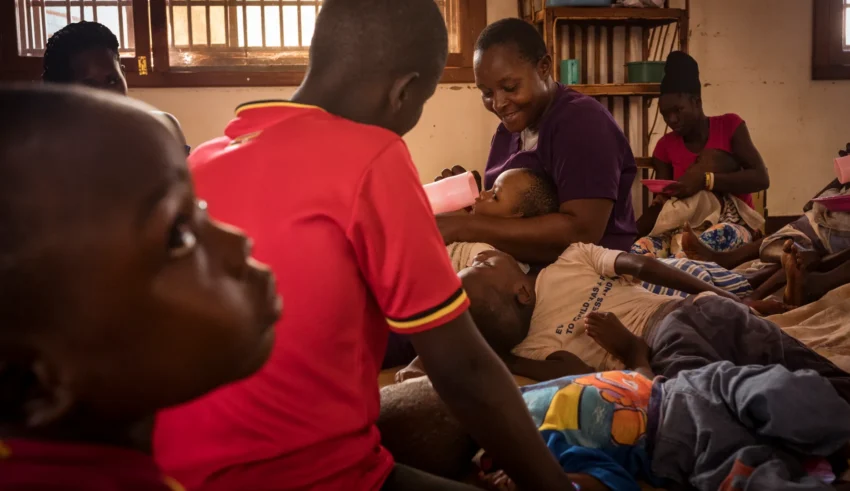
Jinja District, Uganda – On a muddy, uneven and unnamed road on the outskirts of the eastern city of Jinja, children laugh and play in a compound surrounded by green hills and sugarcane plantations.
A child hurtles his wheelchair down the driveway at breakneck speed towards a heavy gate manned by a friendly security guard. On the worn concrete veranda, a young boy with hydrocephalus – a condition in which fluid enlarges the skull – laughs loudly as he plays checkers with two friends.
The cheerful atmosphere belies the difficult backgrounds of the 98 children – aged six months to 18 years – who live on the compound. All were abandoned. Most were babies when their parents left them. Some were left at the compound gate, others at hospital after they were born while one three-year-old boy was rescued from his home days after his parents disappeared.
Today, more than six million people in Uganda, a country of nearly 50 million, live with a disability. Many consider disability to be a burden due to a long-held cultural belief that it is a curse.
Families with disabilities are often shunned by their communities and, in the absence of support or knowledge of better practices, often resort to restraint, tethering and forced seclusion. In some cases, children are abandoned due to social stigma and financial hardship. About 31 percent of households with a disability live in poverty.
Just 1 percent of the country’s health budget goes towards helping these families. “A meagre amount,” says Andrew Mubangizi, assistant commissioner for disability. In rural areas in particular, a lack of staffing and resources at government-run clinics means caregivers often have to travel long distances to access support.
However, for the past two decades, small, donor-funded organisations and charities dotted around the country have tried to fill the void left by the health system to care and advocate for those living with disabilities.
One of the people leading the movement is Edith Lukabwe, who is raising the 98 children at her Home of Hope orphanage. She hopes that educating small pockets of her local community to raise awareness will balloon into a more accepting society. “[People] can then teach their communities. … There shouldn’t be a cultural stigma,” she says.
On a humid, late afternoon in November, Edith sits giggling loudly and bantering with two older members of her team during a lull between heavy rain showers. They watch as younger staff members dodge puddles and sweat through a daily aerobics routine in the muddy courtyard.
As energetic pop music blares across the compound made up of three single- and double-storey buildings, seven-year-old Diego, who has cerebral palsy, heads up a concrete ramp towards a therapy room. His wrists twisted, he crawls forward slowly until Edith spots him.
“Diego, my boy!” the 49-year-old calls out with a wide grin.
She runs over to him, her loose dress billowing as she scoops him up and swings him quickly onto her hip. He gives her a high five, and the two laugh before turning their attention to the workout.
The warmth and affection between Edith and her staff and the children at the orphanage make the place feel like it belongs to a very large family.
Edith’s own journey as a disability rights figure in Uganda began in 2000 with the birth of her first child, Derrick, in Jinja.
When Derrick was two days old, he turned yellow and cried excessively. So Edith and her husband, Richard, took him to a hospital where he was misdiagnosed with malaria. For two weeks, their son suffered convulsions, and upon seeing another doctor, he was found to have complications with his spinal cord after contracting meningitis.
“When he made three months, this is when I realised that my son was not growing as a normal child. He had poor head control. He had a curved spinal cord. He was very floppy,” Edith recalls while sitting in her office. Its walls are adorned with certificates of appreciation and merit, and a portrait of President Yoweri Museveni hangs above the door.
As she looks out a window onto a playground full of children, Edith recalls how she and Richard struggled to get information about their son’s condition and were ostracised by their friends and family who were fearful of them and Derrick.
“We started coming into the hospital, in and out. Home, hospital, home, hospital. And with his situation, especially with convulsions, people were like, ‘He has got epilepsy. He has demons.’ And this is where I was rejected by the community,” she says.
“They were like, ‘She gave birth to a demon-possessed child.’”
Historically and until today, education about disabilities has not been promoted through government-run schools or local clinics, leading many Ugandans to resort to traditional healing. Without a diagnosis and feeling helpless, Edith succumbed to social pressure and took her son to traditional healers.
“I tried to take him to different witch doctors. They were cutting him all over the body, smearing him with their herbs, washing him with blood of the chicken, the blood of the goat. They could take us in at night to shower us with the blood of the chicken, but still, Derrick didn’t change,” she recalls. “It was just worsening.”
But then an elderly couple at her church encouraged her to return to the hospital and supported her family. So Edith returned with Derrick to the hospital. After 12 months, he was diagnosed with permanent disability. The prolonged lack of treatment for meningitis had led to severe brain damage and cerebral palsy, leaving him nonverbal and unable to walk or feed himself for the rest of his life.
Hoping to help with Derrick’s lack of mobility, Edith started attending a physical therapy session with him at the local government hospital.
There she met other mothers and grandmothers who brought their children with different disabilities. She was shocked to see how malnourished some of them were.
Edith took note of the techniques the therapists and the nurses were using. The nurses taught her how to better care for Derrick. They showed her how to mash his food so he could swallow more easily, for example. Meanwhile, Edith befriended the other women who attended and with her newfound knowledge began offering to help them with small tasks, like cutting their children’s nails.
“Mama, can I help to cut off these nails?” she recalls asking them, explaining that because they were long the child could injure themself.
Grateful, the women started to bring her food whenever they came to the hospital. “So we became such friends. So I started visiting them once in a week,” Edith recounts.
Although she suspected neglect was behind some of the children’s poor states, she was shocked when she visited the homes and saw how some were being locked inside – a consequence of stigma, a lack of support and education, and poverty.
“It broke my heart that every time I was going to visit the grandma, I found this child locked in the house. The child has been there for the whole day,” she explains. “That’s the moment I knew I wanted to help.”
Edith began an informal support group at the hospital where she and others attending the therapy sessions would pool together money, usually about 1,000 Ugandan shillings ($0.30), and give it to someone among them who needed it most. Meanwhile, the therapists working with Derrick and the other children moved them to a local charity. After seeing Edith’s work, the charity offered her a job visiting the parents of children with disabilities to provide support and therapy.
But the work was unpaid, and she and Richard now had two more children alongside a three-year-old Derrick to raise on just one salary. Edith soon quit. About that time, she had a car accident that left her with a spinal cord fracture and an open head injury. “I ended up in the hospital, in Jinja hospital, for a year,” she says.
Richard was left to care for the children, which left less time for work. This period was very difficult on her family and marriage, Edith says, but she resolved to push through.
“After six months at home, I was able to begin putting my assistive devices down, and I started walking,” she recalls.
“I say to God that if you heal me, I’ll take care of the disabled children.”
As she recovered, she would spend the day on the porch of her family’s rented home, often seated in a wooden chair, to look after Derrick. Wanting to help the families she had assisted before her accident, Edith asked her cousin to bring the children to her home. Within a month, she was caring for six children, including her son.
Soon after, two babies were left on her doorstep. She believes they were abandoned due to the taboo surrounding disability and left with her as a result of gossip within the community. “They were like … ‘She’s taking care of those children with demons. I think it’s the demons which also caused her accident due to her son,’” Edith says with sadness in her voice.
Edith worked with the local village elder to try to locate the abandoned babies’ parents, but their efforts were unsuccessful.
She was then obliged to formalise their adoption. She did this by registering her work as a caregiver at a community-based organisation and orphanage in 2007. The Home of Hope started on the porch of her house, and then in 2013 with the help of international donors, she was able to move her growing organisation – and her family – to the large open compound they are at today.
Edith recalls this as a happy time for her and Derrick. She would take him for walks in his wheelchair outside the compound and remembers how he’d smile brightly at passers-by. Ever since he was born, she had shared a bed with Derrick to watch over him and never stayed away from him for too long because he would cry out for her whenever she left the room. Derrick was “a blessing for the family”, she says.
In 2014, as Edith was now raising four of her own children and a growing number of others at the orphanage, Derrick died of cardiac arrest after a short illness. He was 14.
Derrick’s death devastated Edith. “This is my own womb, my own blood, my own child. I can’t even know how to express that. I still have pain. I’m just learning to live with that pain,” she says softly.
The home suffered. “It perished,” she says.
But over time, she started to think about how to channel her grief into her work and expand it in Derrick’s memory.
Edith says she thinks of him during happy times, but also when things are difficult. “In tough times, I feel I wish he was by my side,” she admits.
“Every time I was with him, we could laugh. He could bring that smile. Whenever I was stressed, I could look at him, and he gives me that bright, light smile,” she recalls.
“The love was a really happy memory.”
It is because of Derrick that Edith says she is doing what she does today.
“I don’t want this [home] to exist when I’m alive and then when I get out of the world, it dies. I know children with disability will continue to exist,” she explains.
Edith set up a hospital to both honour her son and allow the organisation to be more self-sufficient. Home of Hope is 99 percent funded by international donors, and Edith was able to raise the money to build a fully staffed hospital for the children who live on the compound. It’s also open to the local community.
Richard, who oversees all the maintenance, looks after a chicken hatchery that provides the kitchen with eggs and meat.
The organisation hosts therapy and social work students from Europe as volunteers to supplement the work of the full-time staff. Two of Edith and Richard’s sons also work there: Denis, 24, is the operations director, and Francis, 20, is a nurse.
Most recently, they built an assisted living home in nearby Buwenge for those aged 18 and older who are too old to legally live in the compound.
At the main orphanage, the once bright paint on the walls is faded and shows the strains of time, but it continues to provide warm, comfortable bedrooms with animal decals and bunk beds, three meals a day and children’s activities.
Yet its work stretches beyond the high brick wall surrounding it.