ISLAMABAD:
Pakistan on Friday accused India of deliberately manipulating river flows in violation of the Indus Waters Treaty (IWT), warning that New Delhi’s actions threaten regional stability, international law and the livelihoods of millions of people downstream.
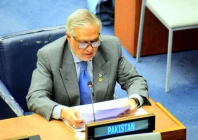
Addressing diplomatic corps in Islamabad, Deputy Prime Minister and Foreign Minister Senator Ishaq Dar said India’s decision earlier this year to hold the 1960 Indus Waters Treaty in abeyance amounted to a “gross contravention” of international law, including the Vienna Convention on the Law of Treaties.
He said Pakistan was now witnessing “material breaches” of the treaty, citing unusual and abrupt variations in the flow of the River Chenab on two occasions this year — from April 30 to May 21, and again between December 7 and 15.
“These sudden changes in river flows point to unilateral water releases by India, carried out without prior notification or data-sharing, as explicitly required under the treaty,” he said, adding that such actions were of “extreme concern” for Pakistan.
The foreign minister said Pakistan’s Indus Water Commissioner had formally sought clarifications from his Indian counterpart under treaty provisions, warning that India’s conduct amounted to the “weaponisation of water”.
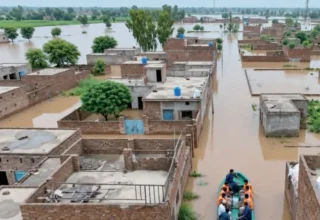
He said the timing of the water manipulation was particularly alarming as it coincided with a critical phase of Pakistan’s agricultural cycle, directly threatening food security, livelihoods and the broader economy.
The minister accused India of systematically undermining the treaty through the construction of hydropower projects such as Kishanganga and Ratle, which he said violated the treaty’s technical specifications, as well as by building dams aimed at creating faits accomplis.
“With increasing storage capacity, India’s ability to manipulate water flows is growing, endangering the security, economy and livelihoods of Pakistan’s 240 million people,” he said.
He also said India had halted the sharing of hydrological data and joint oversight mechanisms mandated under the treaty, exposing Pakistan to heightened risks of floods and droughts, and warned that continued violations could trigger a humanitarian crisis.